About 319 minutes
The Last Stroke: A Detective Story — Text and Context
Fantasy Juvenile Worlds
73,360 recorded words. 3 minutes difference from this book's estimate.
View Gutenberg source #35304
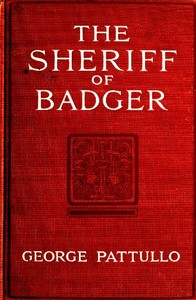
This digital edition of The Sheriff of Badger: A Tale of the Southwest Borderland — Story, Setting & Ideas is described by source-level measurements including 72,549 words, 5 hr 16 min estimated reading time, and 8 detected text sections.
The text analysis averages about 12.4 words per sentence, while the detected sections provide another way to judge how the source is divided.
Project Gutenberg metadata also associates the work with “Western stories,” connecting these edition facts with the source record’s subject description.
Explore this collection
These alternatives are selected using recorded categories and estimated reading time.
About 319 minutes
Fantasy Juvenile Worlds
73,360 recorded words. 3 minutes difference from this book's estimate.
View Gutenberg source #35304About 297 minutes
Fantasy Juvenile Worlds
68,309 recorded words. 19 minutes difference from this book's estimate.
View Gutenberg source #36211About 289 minutes
Fantasy Juvenile Worlds
66,441 recorded words. 27 minutes difference from this book's estimate.
View Gutenberg source #33945Search stored excerpts and compare books → Choose by your preferences →
Choices use stored catalog measurements. Estimates vary with reading speed. A shared category is a catalog label, not a claim that two books have the same argument or literary quality.
Search reads excerpt text stored with this catalog and links to its associated Gutenberg record. The connection is stored in the site database; this tool does not recheck that every excerpt is word-for-word identical to that external record. Excerpt search does not cover every chapter and does not verify historical publication dates.
Catalog snapshot checked: 2026-09-26. Coverage: 91 public books, 91 available source excerpts.
Calculated from edition completeness, EPUB availability, text structure and catalogue metadata. Not a user rating.
Total of 100 points, scaled to a 2.5-5.0 range. Editions with an empty description or a missing EPUB file are not scored.
Public-domain source text
The source text is kept in the dedicated reader, separate from this catalogue record and its commentary.
George Pattullo's The Sheriff of Badger opens not with a gunshot but with a groom's panic: Lafe Johnson, moments before his wedding, misplaces the ring, turns "pea-green," and is saved only because a friend had taken the ring for safekeeping. The scene establishes a pattern that runs through the excerpts—Pattullo juxtaposes western conventions (a cowboy topping an outlaw mule, a silver-plated six-shooter as a gift) with domestic comedy and precise, almost anthropological cataloging of frontier life.
The narrator's voice is notably detached and wry. When describing the wedding presents, he notes that a piano lamp "was made for gas—and they would be lucky, indeed, always to have oil in the Cañon" and that "there was not a piano in Badger." Such observations ground the story in material reality, suggesting that Pattullo is as interested in the social fabric of a border town as in its shootouts.
The wedding chapter in the excerpts functions less as a romantic climax and more as a ledger of frontier material culture. Pattullo lists gifts with the thoroughness of a county clerk: a chromo lithograph of Elijah, a milch cow, a black saddler, a check for fifty dollars, and "shawls and cruetstands, coffee pots and tidies and chair scarfs." The express agent's go-cart, hidden in the barn, is treated as a running joke. The narrator even pauses to note that "in any report of a wedding, it is proper to itemize the plunder."
This cataloging serves multiple purposes. It establishes the economic realities of Badger—a town where a gas lamp is a luxury even without gas—and it gives the reader a concrete sense of the community's priorities. The gifts are practical (a cow, a horse) or aspirational (the lamp, the chromo), and the narrator's dry commentary undercuts any sentimentality. The wedding itself is nearly upstaged by the inventory, suggesting that for Pattullo, the social bonds of a frontier town are best measured in objects exchanged.
The excerpts repeatedly contrast Lafe Johnson's visible anxiety with Hetty's composure. Before the wedding, Lafe is "wretched, gazing miserably out of the window," unable to eat, and his face turns "a pea-green shade" when he thinks he has lost the ring. His friend Turner comments that Lafe kept taking the ring out so often "to look at it, I was scared he'd wear it out." In contrast, the bride is described as "rather pale, but entirely composed." The narrator explicitly denies the reader access to Hetty's dressing room: "Hetty is dressing by the aid of Mrs. Horne and Mrs. Floyd, and no peeping is permissible there."
This asymmetry is consistent with the novel's title—the sheriff is the focal point, and his emotional state is laid bare. Hetty remains more opaque, her interior life hinted at only through the gifts she receives and the narrator's refusal to describe her preparations. The effect is to center Lafe's perspective while suggesting that the women in the story operate in a sphere the narrator will not fully penetrate.
The chapter titles in the table of contents reveal a structure that alternates between western action and domestic life: "A Fight in the Dark" sits alongside "The Bride is Lost" and "Birth of Lafe Johnson, Jr." The excerpts themselves show this blend. The wedding scene includes a cowboy "topping an outlaw mule" and the gift of a "silver-plated six-shooter," but the focus is on the ceremony, the nervous groom, and the catalog of household goods.
Pattullo's narrator treats both violence and domesticity with the same matter-of-fact tone. The same voice that describes a gunfight later notes that "Mrs. Horne was vastly gratified" by the wedding finery. This evenness suggests that the novel does not see a contradiction between the two worlds; rather, it presents frontier life as a continuum where a man can be both a gunman and a husband. The excerpts do not reveal how these threads resolve, but the juxtaposition is consistent enough to suggest that Pattullo is deliberately merging the conventions of the western with those of domestic fiction.
Readers approaching The Sheriff of Badger should attend to Pattullo's narrative voice, which is more ironic and detail-oriented than many westerns of the period. The excerpts suggest a novel that is as interested in the texture of daily life—what people eat, wear, and give as gifts—as in the shootouts and chases. The wedding scene, with its inventory of presents and its focus on Lafe's nerves, offers a useful entry point into the book's sensibility: a blend of frontier action and domestic comedy that resists easy categorization.
That rainy afternoon, Lafe Johnson’s wedding-gift inventory—a piano lamp for a town without gas—kept me smiling. Pattullo’s eye for the absurdly practical lingered. Later, idly tracing that same dry humor about mismatched domesticity, I found myself in another frontier household, where similar quiet incongruities unfurl at their own pace: Barrington. Volume 1 (of 2) — Story, Setting & Ideas. The rain never stopped, and neither did the gentle amusement.
Save your reaction, strongest insight, and memorable passage.