About 448 minutes
When 'Bear Cat' Went Dry — Text and Context
Fantasy Juvenile Worlds
102,953 recorded words. 43 minutes difference from this book's estimate.
View Gutenberg source #34057
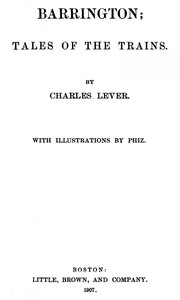
The catalog record for Barrington. Volume 1 (of 2) — Story, Setting & Ideas provides practical reading context through 112,921 words, 8 hr 11 min estimated reading time, and 12 detected text sections.
The text analysis averages about 20.7 words per sentence, while the detected sections provide another way to judge how the source is divided.
Project Gutenberg metadata also associates the work with “Inheritance and succession -- Fiction,” connecting these edition facts with the source record’s subject description.
Explore this collection
These alternatives are selected using recorded categories and estimated reading time.
About 448 minutes
Fantasy Juvenile Worlds
102,953 recorded words. 43 minutes difference from this book's estimate.
View Gutenberg source #34057About 420 minutes
Fantasy Juvenile Worlds
96,558 recorded words. 71 minutes difference from this book's estimate.
View Gutenberg source #33789About 394 minutes
Fantasy Juvenile Worlds
90,456 recorded words. 97 minutes difference from this book's estimate.
View Gutenberg source #36123Search stored excerpts and compare books → Choose by your preferences →
Choices use stored catalog measurements. Estimates vary with reading speed. A shared category is a catalog label, not a claim that two books have the same argument or literary quality.
Search reads excerpt text stored with this catalog and links to its associated Gutenberg record. The connection is stored in the site database; this tool does not recheck that every excerpt is word-for-word identical to that external record. Excerpt search does not cover every chapter and does not verify historical publication dates.
Catalog snapshot checked: 2026-09-26. Coverage: 91 public books, 91 available source excerpts.
Calculated from edition completeness, EPUB availability, text structure and catalogue metadata. Not a user rating.
Total of 100 points, scaled to a 2.5-5.0 range. Editions with an empty description or a missing EPUB file are not scored.
Public-domain source text
The source text is kept in the dedicated reader, separate from this catalogue record and its commentary.
The first chapter of Barrington. Volume 1 (of 2) opens not with an aristocrat or an inheritance dispute, but with a detailed description of a small Irish inn called the Fisherman's Home, located on the river Nore. The narrator dwells on the inn's unpretentious character, its orchard of pear and damson trees, and the churlish secrecy of the anglers who frequent it. The landlord is a reduced gentleman who values privacy over profit. This setting, rather than any grand estate, forms the initial stage for the novel's social interactions.
The inn is presented as a place of quiet comfort, but the excerpts quickly reveal it as a site of careful social negotiation. Major M'Cormick, a local who has long lived in a "nothing-for-nothing world," is uneasy about appearing at the inn as a paying guest rather than an invited one. His instructions to a messenger—to order dinner for two, emphasizing that the Captain will pay—show his anxiety about cost and status. The messenger's "shrewd twinkle" suggests that M'Cormick's penny-pinching is well known. This episode, set against the inn's rustic charm, illustrates how the novel uses a seemingly simple locale to explore class anxieties and economic calculations.
The excerpts focus heavily on Major M'Cormick, a character defined by his selfishness and suspicion. The narrator notes that "the selfishness of an unimaginative man is the most complete of all," yet it also protects him from delusions. M'Cormick thinks ill of the world and expects little generosity. When a dashing Captain of Hussars seeks him out and invites him to dinner, M'Cormick is puzzled and wary. His internal monologue—"Maybe I 'll have to order the bill too!"—reveals a mind constantly calculating costs and obligations. This portrait of a man who has adapted to a "nothing-for-nothing world" is one of the most vivid elements in the opening chapters.
The novel is set in Ireland "some forty years ago" from its publication, and the excerpts convey a specific sense of place. The river Nore, the cliffs with larch and ash, and the high mountain are described in careful detail. The narrator's voice is wry and observant, as when he notes that the inn's pledge of a "Home" was "honestly fulfilled." The dialogue, too, captures character: M'Cormick's grumbling replies and the Captain's polished offers. However, the catalog subjects of inheritance and aristocracy are not yet prominent; the excerpts show a world of fishermen, a reduced gentleman, and a cautious major, rather than the high-stakes property disputes the catalog might suggest.
Readers approaching Barrington. Volume 1 (of 2) should set aside expectations of a straightforward inheritance drama. The excerpts suggest a novel more interested in social comedy and character study, centered on the Fisherman's Home and its visitors. Pay attention to the narrator's ironic asides and the economic subtext of every social interaction. The illustrations by Phiz (Hablot Knight Browne) may further enrich the depiction of these Irish scenes.
Years at this desk have taught me that some books keep a quiet kinship, like old friends who never met. Lever’s Barrington, with its poky inn and Major M’Cormick’s careful pennies, shares a knowing glance with The Comstock Club — Themes and Context. Both smell of lamp oil and unspoken thrift, where character shows in small, stubborn habits rather than grand gestures. I find that companionship comforting.
Create a short personal record of your experience with this book.