About 315 minutes
The Man from Archangel, and Other Tales of Adventure — A Reader’s Guide
Adventure Picaresque Fiction
72,333 recorded words. 3 minutes difference from this book's estimate.
View Gutenberg source #34797
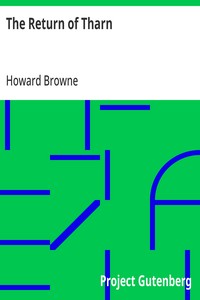
The source record for The Return of Tharn — Key Ideas to Explore measures this digital text at 72,992 words, 5 hr 18 min estimated reading time, and 7 detected text sections.
The text analysis averages about 16.7 words per sentence, while the detected sections provide another way to judge how the source is divided.
Project Gutenberg metadata also associates the work with “Adventure stories,” connecting these edition facts with the source record’s subject description.
Explore this collection
These alternatives are selected using recorded categories and estimated reading time.
About 315 minutes
Adventure Picaresque Fiction
72,333 recorded words. 3 minutes difference from this book's estimate.
View Gutenberg source #34797About 328 minutes
Adventure Picaresque Fiction
75,342 recorded words. 10 minutes difference from this book's estimate.
View Gutenberg source #33279About 331 minutes
Adventure Picaresque Fiction
76,004 recorded words. 13 minutes difference from this book's estimate.
View Gutenberg source #34664Search stored excerpts and compare books → Choose by your preferences →
Choices use stored catalog measurements. Estimates vary with reading speed. A shared category is a catalog label, not a claim that two books have the same argument or literary quality.
Search reads excerpt text stored with this catalog and links to its associated Gutenberg record. The connection is stored in the site database; this tool does not recheck that every excerpt is word-for-word identical to that external record. Excerpt search does not cover every chapter and does not verify historical publication dates.
Catalog snapshot checked: 2026-09-26. Coverage: 91 public books, 91 available source excerpts.
Calculated from edition completeness, EPUB availability, text structure and catalogue metadata. Not a user rating.
Total of 100 points, scaled to a 2.5-5.0 range. Editions with an empty description or a missing EPUB file are not scored.
Public-domain source text
The source text is kept in the dedicated reader, separate from this catalogue record and its commentary.
The narrative of The Return of Tharn moves between two distinct modes: the close, sensory tracking of a lone hunter through primeval forest and the formal, almost courtly exchanges among tribal leaders and captives. The opening chapter introduces Trakor, a young Cro-Magnon who "moved at a swinging trot along a winding game trail," his body "bathed in perspiration" as he frets over his late return. Browne lingers on physical details—the "flint-tipped spear" transferred from hand to hand, the "slippery spear shaft" that could mean death—to ground the reader in a world where survival depends on constant vigilance.
Later scenes shift abruptly to dialogue-heavy confrontations, as when Dylara declares herself "the daughter of Majok, chief of a tribe" to the Ammadian captain Ekbar. This juxtaposition of solitary peril and social maneuvering gives the novel a rhythm of isolation and encounter, each section building tension through a different register.
Browne frequently anchors the reader in a character's immediate sensory experience, especially during movement through the jungle. Trakor's initial trek is described through a series of physical adjustments: he "rubbed dry the sweating palm of his right against his loin cloth" because a slippery spear could mean death. The prose follows his eyes as they note "occasional rifts in the matted mazes of branches" and the "dusty elephant path under his naked feet." This close attention to texture—the heat, the damp, the shifting light—creates a palpable environment.
Later, when Tharn and Trakor sit by a stream, the narrative again narrows to what they hear and see: the "faint stirring among the river reeds" that heralds Tarlok the leopard, the "cool breeze" that masks their scent. Browne uses these moments of stillness to heighten the threat, letting the reader share the characters' held breath. The pattern recurs throughout: a character pauses, the world narrows to a few details, and danger emerges from the periphery.
The novel's prehistoric setting is built partly through a consistent naming system for animals and natural forces. Lions are "Sadu, monarch of the jungle night"; the wind is "Siha"; the leopard is "Tarlok." These capitalized names, used without explanation, treat the creatures as almost mythic figures while also grounding them in a specific cultural vocabulary. Trakor thinks of "Neela, the zebra, or Bana, the deer" as game, and his own clothing is "the pelt of Jalok, the panther."
This naming convention extends to human interactions: Dylara identifies herself by her father's name and tribe, and the Sepharian captain Ekbar speaks of "the noble Jotan" and "the noble Vokal" with a formality that contrasts with the raw physicality of the hunt. The juxtaposition suggests a world where social hierarchy and wild nature coexist uneasily, each governed by its own codes.
The excerpts show a clear structural alternation between scenes of solitary or paired travel and scenes of crowded, often tense dialogue. Trakor's opening journey is entirely internal—his thoughts circle around Lanoa, his own foolishness, and the approaching night. He is alone with his spear and his dread. Then the narrative cuts to Dylara's confrontation with Ekbar, a scene built entirely on spoken exchange: "I am the noble Jotan's," she says, and he replies with mock humility. The setting shifts from the forest's "matted mazes" to a cleared road or camp where social rank and deception matter more than tracking.
This back-and-forth continues in the later excerpt, where Tharn and Trakor sit in silence by a stream, then watch a leopard drink, then speak only to plan their next move. Browne uses the quiet stretches to build atmosphere and the dialogue scenes to advance the plot, creating a rhythm that keeps the reader moving between introspection and confrontation.
Two elements recur across the excerpts: fire and water. The novel opens with a lion springing "over the burning stockade," and later the clearing where Jotan's party was attacked shows "ashes from the long-dead fires" still visible. Fire marks both destruction and the passage of time. Water appears as a site of both relief and danger: Trakor and Tharn "knelt at the stream and quenched their thirst," but the same stream is where Tarlok the leopard appears, and the rustling reeds signal a predator's approach.
These elements are never merely decorative. The ashes are "tracked now by the hoofs and paws of jungle beasts," showing how quickly human presence is erased. The stream offers a moment of shared stillness before the leopard emerges. Browne uses fire and water as anchors for the setting's impermanence, reminding the reader that this world is always in flux, always threatening to reclaim its own.
Readers will find that the novel's effectiveness depends less on plot mechanics than on the texture of its world. Pay attention to how Browne shifts between the hunter's narrowed focus and the formal speech of tribal politics—each mode reveals a different facet of the same harsh landscape. The recurring names for animals and the careful placement of fire and water scenes reward a slow reading that savors the sensory details. The excerpts suggest a work that values atmosphere over speed, and the gaps in the text leave much of the larger story to inference.
Sometimes a story stays because it makes the wild places feel real—the hunts, the quiet politics between peoples. That same lingering ache came back to me with Nevermore — Text and Context, where the shadows aren’t jungle but memory. It doesn’t move like a plot so much as a mood that settles. I found myself thinking about it days later, just like Tharn’s world.
Create a short personal record of your experience with this book.