About 305 minutes
Leonora — Reading Notes
Psychological Domestic Love Stories
69,956 recorded words. 13 minutes difference from this book's estimate.
View Gutenberg source #35638
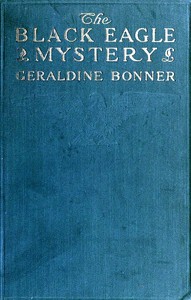
The source record for The Black Eagle Mystery — Text and Context measures this digital text at 73,133 words, 5 hr 18 min estimated reading time, and 25 detected text sections.
The text analysis averages about 16.7 words per sentence, while the detected sections provide another way to judge how the source is divided.
Project Gutenberg metadata also associates the work with “Detective and mystery stories,” connecting these edition facts with the source record’s subject description.
Explore this collection
These alternatives are selected using recorded categories and estimated reading time.
About 305 minutes
Psychological Domestic Love Stories
69,956 recorded words. 13 minutes difference from this book's estimate.
View Gutenberg source #35638About 298 minutes
Psychological Domestic Love Stories
68,504 recorded words. 20 minutes difference from this book's estimate.
View Gutenberg source #34619About 340 minutes
Psychological Domestic Love Stories
77,988 recorded words. 22 minutes difference from this book's estimate.
View Gutenberg source #35414Search stored excerpts and compare books → Choose by your preferences →
Choices use stored catalog measurements. Estimates vary with reading speed. A shared category is a catalog label, not a claim that two books have the same argument or literary quality.
Search reads excerpt text stored with this catalog and links to its associated Gutenberg record. The connection is stored in the site database; this tool does not recheck that every excerpt is word-for-word identical to that external record. Excerpt search does not cover every chapter and does not verify historical publication dates.
Catalog snapshot checked: 2026-09-26. Coverage: 91 public books, 91 available source excerpts.
Calculated from edition completeness, EPUB availability, text structure and catalogue metadata. Not a user rating.
Total of 100 points, scaled to a 2.5-5.0 range. Editions with an empty description or a missing EPUB file are not scored.
Public-domain source text
The source text is kept in the dedicated reader, separate from this catalogue record and its commentary.
The Black Eagle Mystery opens with a foreword explaining that the narrative is compiled from documents contributed by two participants: Molly Morgenthau Babbitts and John Reddy. This framing device immediately signals a layered storytelling approach, where the reader receives a filtered account from inside observers. The first chapter, narrated by Molly, establishes her distinctive voice—colloquial, self-aware, and peppered with asides about her marriage to a reporter nicknamed Babbitts. She references a prior case, the Hesketh Mystery, to locate herself and her husband, but insists she is too eager to proceed to recount it. This technique both rewards returning readers and creates a sense of ongoing serial intrigue.
Molly Morgenthau Babbitts narrates the first chapter in a style that blends domestic comedy with crime reporting. She calls her husband “Soapy” (the reporters’ nickname) and “Himself,” explaining that her Irish mother’s speech influences her. She refers to herself as “Morningdew,” a cute Americanization of her maiden name Morgenthau. Her tone is breezy and confiding: she describes their apartment as “furnished like a Belasco play” and mentions ordering around a maid named Isabella Dabney while hoping Isabella doesn’t see through her inexperience. This voice is not merely decorative; it establishes Molly as a character who navigates between social classes and narrative roles—she is both a former telephone operator and a detective’s wife, an insider to the mystery but also a participant in its domestic backdrop.
The excerpts reveal a crime that is both savage and mysterious: Mr. Harland’s body found on the sidewalk, and an attack on a man named Ford in his lodging house. The narrative shifts to John Reddy’s perspective, who describes a suspect—a girl who may have fallen under the spell of a man named Barker. Reddy reflects on her “stealthily watching eyes with their leaping fires” and her equivocations and lies, yet he cannot believe her guilty. The attack on Ford is described in detail: a small man with glasses and an aquiline nose enters the lodging house, and later a raised voice is heard saying “I’ve come…” The police investigation yields meager descriptions, emphasizing the difficulty of identifying the assailant. The catalog subjects list this as a detective and mystery story, but the excerpts focus more on the psychological state of the suspect and the narrator’s internal conflict than on procedural detection.
The foreword explicitly states that the story is compiled from documents by two contributors, suggesting a multi-perspective structure. Molly’s first-person narration in Chapter I is chatty and immediate, while later sections shift to John Reddy’s more analytical voice. The excerpts show Reddy reflecting on the case, walking miles to think, and describing events in chronological order. This alternation between narrators may create a contrast between Molly’s personal, domestic lens and Reddy’s more detached, investigative tone. The catalog subjects also include “Psychological” and “Domestic & Love Stories,” which aligns with the excerpts’ emphasis on relationships—Molly’s marriage, the suspect’s possible romantic entanglement with Barker, and the emotional turmoil of those involved. The mystery is thus embedded in a web of personal connections and psychological states, not just clues and alibis.
Readers should attend to the way the two narrators’ voices shape the unfolding of events. Molly’s asides and Reddy’s ruminations offer different kinds of evidence—one emotional and anecdotal, the other more systematic. The excerpts do not reveal the resolution, but they suggest that the mystery hinges on character and motive as much as on physical clues. The domestic setting and the narrator’s personal stakes make this a hybrid of detective story and character study.
Sitting with Molly and John’s tangled documents, I kept thinking about how the crime wasn’t the real weight—it was the quiet gap between two people who knew each other and didn’t. The fallen man, the equivocal glances. That same ache surfaced in I, Thou, and the Other One: A Love Story — Reading Notes, where intimacy turns sideways. One story watches a killer; the other watches a heart, both leaving me with a held breath.
A brief reflection can help important ideas stay with you longer.