About 344 minutes
The Idyl of Twin Fires — Themes and Context
Psychological Domestic Love Stories
78,969 recorded words. 4 minutes difference from this book's estimate.
View Gutenberg source #34177
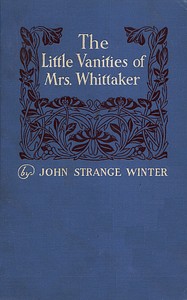
The catalog record for The Little Vanities of Mrs. Whittaker: A Novel — Text and Context provides practical reading context through 77,988 words, 5 hr 40 min estimated reading time, and 10 detected text sections.
The text analysis averages about 17.3 words per sentence, while the detected sections provide another way to judge how the source is divided.
Project Gutenberg metadata also associates the work with “Domestic fiction,” connecting these edition facts with the source record’s subject description.
Explore this collection
These alternatives are selected using recorded categories and estimated reading time.
About 344 minutes
Psychological Domestic Love Stories
78,969 recorded words. 4 minutes difference from this book's estimate.
View Gutenberg source #34177About 351 minutes
Psychological Domestic Love Stories
80,622 recorded words. 11 minutes difference from this book's estimate.
View Gutenberg source #35218About 318 minutes
Psychological Domestic Love Stories
73,133 recorded words. 22 minutes difference from this book's estimate.
View Gutenberg source #35484Search stored excerpts and compare books → Choose by your preferences →
Choices use stored catalog measurements. Estimates vary with reading speed. A shared category is a catalog label, not a claim that two books have the same argument or literary quality.
Search reads excerpt text stored with this catalog and links to its associated Gutenberg record. The connection is stored in the site database; this tool does not recheck that every excerpt is word-for-word identical to that external record. Excerpt search does not cover every chapter and does not verify historical publication dates.
Catalog snapshot checked: 2026-09-26. Coverage: 91 public books, 91 available source excerpts.
Calculated from edition completeness, EPUB availability, text structure and catalogue metadata. Not a user rating.
Total of 100 points, scaled to a 2.5-5.0 range. Editions with an empty description or a missing EPUB file are not scored.
Public-domain source text
The source text is kept in the dedicated reader, separate from this catalogue record and its commentary.
The novel opens with a retrospective narrator who situates Regina Brown's birth in the early 1850s, referencing the Crimean War and the Indian Mutiny as distant clouds. This historical framing quickly gives way to a close, ironic observation of Regina's genteel upbringing—her ringlets, her seminary education. The narrative voice is distinctive: it is confiding, occasionally arch, and fond of parenthetical asides. Winter shifts between broad historical gestures and minute domestic particulars, a technique that establishes the novel's central tension between public ambition and private vanity.
The narrator speaks directly to the reader, using phrases like “I must go back” and “So far as I have ever heard,” creating a sense of shared confidence. This voice is not omniscient in a detached sense; it is opinionated, offering judgments such as “plain, simple and homely Brown, without even so much as an ‘e’ placed at the tail thereof.” The tone is gently mocking but not cruel. When Regina dusts her face with powder, the narrator describes her as looking “like a gigantic perambulating baby’s bassinette,” a simile that is both vivid and deflating. This narrative intimacy allows Winter to expose Regina's self-deceptions while maintaining sympathy.
The novel's pace is uneven, mirroring the rhythms of middle-class domesticity. Long passages of description and interior monologue—such as Regina's careful application of powder—are punctuated by sudden bursts of dialogue or action. In the excerpt, the leisurely account of Regina's toilette is abruptly broken by her husband's arrival and his brisk command: “Here, drink this down at once.” The shift from introspection to direct speech creates a jolt, emphasizing the contrast between Regina's inner world and the external demands of her marriage. Winter uses these changes in tempo to underscore moments of decision or concealment.
Small objects carry significant narrative weight. The powder-box, the glass of port, the smoking-jacket—each recurs or is described with precision. Regina's use of Maudie's abandoned powder-box signals her tentative entry into a realm of feminine artifice she had previously scorned. The port wine, offered by Alfred, becomes a symbol of his old-fashioned care and her momentary submission. Winter lingers on these details, giving them a psychological charge. The smoking-jacket, which Regina admires “as some women admire their husbands when they get drunk,” suggests a longing for release from convention. These recurring motifs build a texture of meaning beyond plot.
Readers attentive to narrative voice and pace will find Winter's novel a study in restraint and eruption. The story unfolds through small gestures—a dusting of powder, a glass of wine—rather than dramatic events. Pay attention to what the narrator chooses to describe at length and what is passed over quickly; these choices reveal the novel's true concerns. The tension between Regina's strong-mindedness and her vulnerability is rendered not through grand statements but through the accumulation of everyday vanities.
I’ve often thought Mrs. Whittaker’s restless little vanities find a quieter echo in Rachel Gray. That other novel’s plain, suffering heroine never performs for the world, yet both women wrestle with the same private ache—the gap between what they show and what they hoard. One shouts it in silk; the other whispers it in prayer. Rachel Gray: A Tale Founded on Fact — Context and Discussion holds that hush close, like a well-worn bookmark.
Use these questions to collect your thoughts before moving on.