About 298 minutes
The Gateless Barrier — Edition Insights
Psychological Domestic Love Stories
68,504 recorded words. 7 minutes difference from this book's estimate.
View Gutenberg source #34619
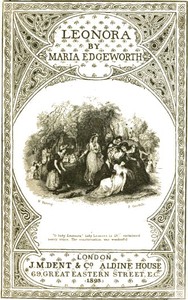
For Leonora — Reading Notes, the stored edition analysis reports 69,956 words, 5 hr 5 min estimated reading time, and 9 detected text sections.
The text analysis averages about 20.4 words per sentence, while the detected sections provide another way to judge how the source is divided.
Project Gutenberg metadata also associates the work with “England -- Social life and customs -- 19th century -- Fiction,” connecting these edition facts with the source record’s subject description.
Explore this collection
These alternatives are selected using recorded categories and estimated reading time.
About 298 minutes
Psychological Domestic Love Stories
68,504 recorded words. 7 minutes difference from this book's estimate.
View Gutenberg source #34619About 318 minutes
Psychological Domestic Love Stories
73,133 recorded words. 13 minutes difference from this book's estimate.
View Gutenberg source #35484About 280 minutes
Psychological Domestic Love Stories
64,263 recorded words. 25 minutes difference from this book's estimate.
View Gutenberg source #35012Search stored excerpts and compare books → Choose by your preferences →
Choices use stored catalog measurements. Estimates vary with reading speed. A shared category is a catalog label, not a claim that two books have the same argument or literary quality.
Search reads excerpt text stored with this catalog and links to its associated Gutenberg record. The connection is stored in the site database; this tool does not recheck that every excerpt is word-for-word identical to that external record. Excerpt search does not cover every chapter and does not verify historical publication dates.
Catalog snapshot checked: 2026-09-26. Coverage: 91 public books, 91 available source excerpts.
Calculated from edition completeness, EPUB availability, text structure and catalogue metadata. Not a user rating.
Total of 100 points, scaled to a 2.5-5.0 range. Editions with an empty description or a missing EPUB file are not scored.
Public-domain source text
The source text is kept in the dedicated reader, separate from this catalogue record and its commentary.
The novel opens with a letter from Lady Olivia to Lady Leonora, declaring that 'to be born a woman' is a misfortune, and that women are 'the slave or the outcast of society.' This rhetorical flourish immediately establishes Olivia's voice—passionate, self-dramatizing, and prone to sweeping claims. Yet the note preceding the letters reveals that Edgeworth began the work after refusing a marriage proposal from a Swedish gentleman, and that she wrote partly for his approbation. The tension between Olivia's theatrical complaints and the author's own lived experience of refusing marriage gives the opening an ironic undertow.
The epistolary form means every statement is filtered through a correspondent's perspective. Olivia's first letter, addressed to Leonora, is already a performance: she laments women's lot while positioning herself as a victim of 'genius and sensibility.' Readers should attend to who writes to whom, and what each correspondent chooses to reveal or conceal.
Olivia's letters are exercises in rationalization. She claims her attachment to L—— is 'involuntary' and her love 'as pure as it is fervent,' yet she also calculates that once L—— decides, 'prudence becomes a duty to ourselves and to Leonora.' The language of duty and sacrifice is deployed to justify continued intimacy. She insists she would not 'plant a dagger in my own heart' without advantage to her friend—a metaphor that makes her own suffering the central concern. Edgeworth lets Olivia's logic unfold without authorial comment, forcing readers to judge the gap between her stated principles and her actions.
Notice how Olivia frames her indecision as a danger to Leonora: 'whilst this uncertainty and his consequent fits of absence and imprudence last, there is hazard every moment of her being alarmed.' The threat is not her own conduct but L——'s failure to decide. This inversion of responsibility is a recurring pattern.
Letter xl introduces a new correspondent, Mrs C——, who writes to Miss B—— from L—— Castle. Her arrival provides an external view of Leonora's deterioration: 'Never was any human being so altered in her looks in so short a time.' Mr L——, by contrast, notices nothing beyond her being 'paler than usual.' The discrepancy between what a visitor sees and what the husband perceives creates dramatic irony. Mrs C——'s plain, observant style contrasts sharply with Olivia's elaborate self-analysis. Her letter grounds the emotional turmoil in physical evidence—a changed complexion, a husband's blindness. This shift in perspective is crucial: it confirms that Olivia's machinations have real, visible effects on Leonora, effects that the novel's central couple seems unable or unwilling to acknowledge.
Edgeworth uses small domestic details to expose the power dynamics at play. In one excerpt, Olivia orchestrates a scene around a dinner bell, a Swiss servant, and a lady's toilette. She notes that the Swiss 'did not even raise his eyes upon me or my coëffure as we passed'—a sign of his 'stupidity' or 'penetration'? Olivia reads his blankness as either dullness or suspicion, revealing her own anxiety about being seen through. She then dismisses the incident as 'nothing more simple, nothing more proper in the meridian of Paris,' as if propriety were a matter of geography. The episode shows how Olivia uses cosmopolitan sophistication to normalize behavior that, in the English setting of L—— Castle, is transgressive. The reader must decide whether the servant's averted gaze is deference, disapproval, or indifference.
Because the novel is told entirely through letters, every event is mediated by a correspondent's interests. Olivia's letters to Gabrielle are confidences that double as performances; Mrs C——'s letter to Margaret is a report that seeks to inform but also to judge. Leonora herself, based on the excerpts, does not write—she is the object of others' observations and schemes. This asymmetry means that readers never have direct access to her thoughts or feelings. Her suffering is inferred from Mrs C——'s alarm and from Olivia's dismissive claim that Leonora is 'perfectly secure, and absolutely blind.' The epistolary structure thus enforces a kind of epistemological limitation: we know Leonora only through the eyes of those who may misread or manipulate her. Edgeworth's choice to withhold Leonora's voice is itself a comment on the position of the woman at the center of the triangle.
Reading Leonora requires attending to who speaks, to whom, and for what purpose. The letters do not simply convey plot; they are acts of persuasion, self-justification, and sometimes self-deception. Edgeworth's own biographical circumstances—writing after refusing a proposal—add a layer of irony to Olivia's claims about female destiny. As you read, track the discrepancies between what correspondents say and what they do, and notice how the novel's structure makes Leonora both the center and the silent figure of the story.
Years among these shelves taught me how letters can hide more than they reveal, as in Leonora, where every kindness carries a small blade. I often think of that quiet ache when I revisit Sarah's first start in life — Inside the Classic, for Sarah, too, learns that the earnest voice we trust may be the one most carefully rehearsed. They whisper to each other across the centuries, these two.
Capture what you thought, learned, and would like to remember.