
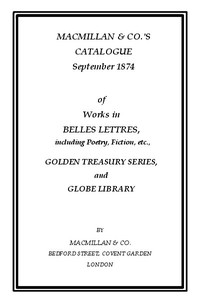
Macmillan & Co.'s Catalogue. September 1874 by Macmillan & Co.
Let's be clear from the start: this is not a novel. There's no protagonist, no villain, and definitely no dramatic climax. Macmillan & Co.'s Catalogue. September 1874 is exactly what it says on the tin: a sales catalog from a major Victorian publisher, listing the books they had available that autumn. It's a simple list, organized by category, with titles, authors, prices, and sometimes a brief descriptive line.
The Story
There's no plot in the traditional sense. The 'story' here is one of potential and discovery. You open the catalog and travel back to a specific month in history. You see sections for History, Biography, Science, Theology, Fiction, and School Books. You read entries like 'The Descent of Man, and Selection in Relation to Sex' by Charles Darwin (New Edition, 12s.)' sitting right next to poetry collections and Greek grammars. The 'narrative' is the journey you take as a modern reader, connecting the dots between these titles. You see what ideas were being sold together, what was considered important enough to publish, and what a middle-class family might have had on their bookshelf. It’s a story about the marketplace of ideas in 1874.
Why You Should Read It
I loved this because it lets your imagination run wild. It's a historian's playground and a book lover's curiosity shop. You get a raw, unfiltered look at the culture without any modern analysis getting in the way. One minute you're looking at a dense philosophical treatise, the next at a 'Handbook of Home Pets'. The juxtaposition is brilliant. It removes the famous names from their pedestals and puts them back on the shelf as products, next to their forgotten contemporaries. Reading this catalog makes history feel tangible and messy, not neat and pre-digested. It’s a quiet, thoughtful experience that I found surprisingly absorbing.
Final Verdict
This is a niche read, but a deeply rewarding one. It's perfect for history buffs, bibliophiles, and anyone with a strong sense of curiosity. If you love wandering through old bookstores just to see what's on the shelves, you'll get a kick out of this. It's not for someone looking for a gripping narrative. But if you've ever wondered what the air felt like, intellectually speaking, in a Victorian drawing room, this catalog is as close as you can get. Think of it as the ultimate browser's history for the 19th-century mind.
No rights are reserved for this publication. Preserving history for future generations.
Edward Hill
8 months agoI have to admit, the depth of research presented here is truly commendable. I will read more from this author.
Liam Nguyen
1 year agoAs someone who reads a lot, the pacing is just right, keeping you engaged. Truly inspiring.
Emma Miller
5 months agoThe fonts used are very comfortable for long reading sessions.
Oliver Thompson
2 years agoAfter finishing this book, it challenges the reader's perspective in an intellectual way. Truly inspiring.




Margaret Moore
4 months agoThought-provoking and well-organized content.