
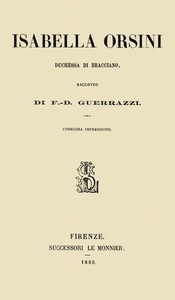
Isabella Orsini, duchessa di Bracciano by Francesco Domenico Guerrazzi
Francesco Domenico Guerrazzi's Isabella Orsini, Duchessa di Bracciano is a historical novel that reads like a political thriller set in velvet and marble. First published in the 1800s, it brings to life the dangerous glamour of the Italian Renaissance with a focus that feels fresh even today.
The Story
The book follows Isabella de' Medici, a real historical figure and the daughter of Cosimo I, Grand Duke of Tuscany. Married to Paolo Giordano Orsini, the Duke of Bracciano, Isabella is intelligent, cultured, and finds herself stifled by her husband's neglect and the restrictive court life. The plot thickens with rumors, infidelity, and the brutal power politics of the era. Guerrazzi builds the tension around the deteriorating marriage and the sinister pressures from Isabella's own powerful family. The story moves toward its tragic, historically-inspired conclusion, exploring the dark rumors that have surrounded Isabella's death for centuries. It's less about sweeping battles and more about the quiet, deadly wars fought in palace corridors.
Why You Should Read It
What grabbed me was Isabella herself. Guerrazzi, writing in the 19th century, creates a remarkably nuanced portrait of a woman trying to carve out space for herself. She's not a perfect victim; she's flawed, makes mistakes, and seeks her own pleasures in a system designed to control her. You feel her frustration, her intelligence sparking against the walls of her gilded prison. The book is a fascinating look at how history is often shaped in private rooms rather than on public stages. The atmosphere is palpable—you can almost smell the intrigue and feel the weight of the silks.
Final Verdict
This is a perfect pick for readers who love character-driven historical fiction, especially stories centered on complex women. Think of it as a cousin to books like The Marriage Portrait or The Birth of Venus, but with the passionate, dramatic flair of a 19th-century Italian novelist. It's for anyone who wonders about the real people behind the grand portraits. Fair warning: it's a product of its time in style, so the prose can be ornate, but the human drama at its heart is timeless. If you're ready for a trip to Renaissance Italy that's more about survival than splendor, meet Isabella Orsini.
The copyright for this book has expired, making it public property. It is now common property for all to enjoy.
George Johnson
9 months agoComparing this to other titles in the same genre, the case studies and practical examples provided add immense value. This has become my go-to guide for this specific topic.
Linda Lee
2 months agoAfter a thorough walkthrough of the table of contents, the level of detail in the second half of the book is truly impressive. Thanks for making such a high-quality version available.
Margaret Davis
8 months agoI stumbled upon this title during my weekend research and the author manages to bridge the gap between theory and practice effectively. An excellent example of how quality digital books should be formatted.
Mary Harris
8 months agoGreat value and very well written.







Barbara Martin
6 months agoUnlike many other resources I've purchased before, the transition between theoretical knowledge and practical application is seamless. I’ll definitely be revisiting some of these chapters again soon.